
Why small employers can't afford to get HR wrong
Employment law doesn't scale down. A business with three employees answers to the same tribunal as one with three thousand — and usually without anyone whose job it is to notice.
Most employment disputes don't start with a bad decision. They start with a reasonable decision, taken in a hurry, without the process that would have made it defensible.
That distinction matters more than most small employers realise, because a tribunal is rarely asking whether you were right. It is asking whether you were fair — whether you investigated, whether you told the employee what the problem was, whether you gave them a chance to respond, whether you let them appeal. You can be completely correct about the underlying facts and still lose, because of how you got there.
The law does not scale down
There is no small-business exemption from unfair dismissal, discrimination, or the right to a written statement of employment particulars. A business with three employees is subject to the same Employment Rights Act as one with three thousand. The difference is that the larger business has someone whose job it is to know that, and you probably don't.
Some obligations start on day one, before anyone has settled in. Every employee must have a written statement of their main terms by their first day — that is section 1 of the Employment Rights Act 1996, and it is not satisfied by an offer letter. Discrimination protection applies from the moment you advertise the role: there is no qualifying period, and no cap on what a tribunal can award. Once you reach five employees, you must have a written health and safety policy.
What it costs when it goes wrong
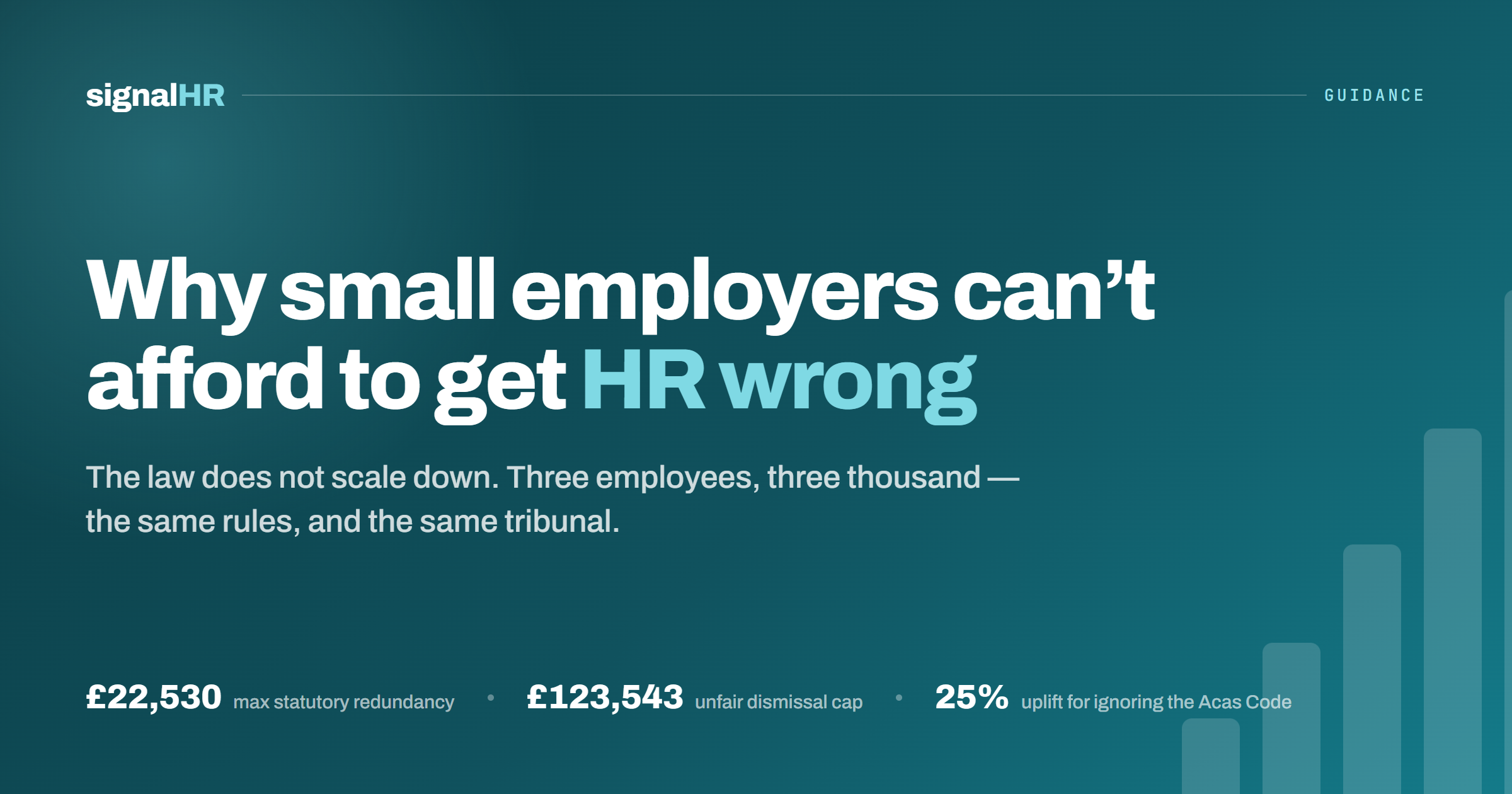
The numbers are not small. Statutory redundancy pay is capped at £751 a week and 30 weeks, so a maximum of £22,530 — before anyone argues the redundancy wasn't genuine. The compensatory award for unfair dismissal is capped at £123,543 or a year's gross pay, whichever is lower.
And there is a specific penalty for skipping process. Where an employer unreasonably fails to follow the Acas Code of Practice on disciplinary and grievance procedures, a tribunal can increase the award by up to 25%. That is a quarter added to the bill purely for how the dismissal was handled, regardless of the reason behind it. It is the single most avoidable cost in employment law, and it is avoided by holding a meeting and writing things down.
The stakes rise twice in the next four months
From 1 October 2026, the time limit for bringing most tribunal claims doubles from three months to six. In practice that means a dispute you thought had gone quiet has twice as long to come back, and your records need to survive twice as long to be any use when it does.
From 1 January 2027, unfair dismissal protection begins at six months' service rather than two years, and the cap on the compensatory award is removed entirely. Together those two changes mean far more of your workforce can bring a claim, and there is no longer a ceiling on what it can be worth. If your probation process currently relies on the two-year window, it stops working in January.
Where to start
You do not need an HR department. You need four things, in this order.
Written terms for everyone, issued by day one and matching what people actually do. Contradictions between the contract and reality are what unravel first.
A disciplinary and grievance procedure that follows the Acas Code, written down and actually applied — including to the difficult cases where it feels like overkill. Those are the ones that end up in front of a judge.
A habit of writing things down at the time. Not a filing system: notes of what was said, when, and by whom. The employer who loses is almost always the one relying on memory a year later.
Someone who checks what has changed. Employment law moved substantially in 2026 and moves again in 2027. Sick pay, family leave, harassment duties and dismissal rights have all changed inside eighteen months.
None of that is expensive. All of it is considerably cheaper than the alternative.
Get UK employment law change alerts
A short email when the law changes and what employers need to do. One or two a month. Free.
General guidance on UK employment law, not legal advice. Commencement dates can move — check the source before relying on a date.